 .AI
.AIQuickstart: build from Claude Code
Install the APIANT skills and MCP server in Claude Code, sign in, then have Claude build, test and turn on a webhook automation that needs no app credentials.
One command from your APIANT account menu installs the APIANT skills into a project directory and registers the APIANT MCP server with Claude Code. After you sign in, Claude builds and tests automations on your account from that directory. This quickstart builds a webhook automation, so you do not need to connect any app.
Prerequisites
- An APIANT.ai account. Create one at app.apiant.ai/register.
- Claude Code 2.1.157 or later, with the
claudecommand on yourPATH. Check withclaude --version. - A model with a context window of at least 1M tokens. The APIANT skills are only compatible with those models.
curlandunzipon Mac or Linux. Windows needs no extra tools.- A browser on the same machine, for the sign-in.
Steps
1. Copy the install command
- Sign in at app.apiant.ai.
- Open the account menu (your initials and name, top right) and select Connect to Claude Code.
- The dialog shows the command for your operating system. Select Copy.
The dialog shows one command and a note about restarting Claude Code and updating later.
2. Run it in your project directory
Open a terminal in the directory you want to work from and paste the command. On Mac and Linux it looks like this:
$ curl -fsSL 'https://app.apiant.ai/appPlugin/plugin.zip' -o /tmp/a.zip && unzip -oq /tmp/a.zip -d . && rm /tmp/a.zip && { claude mcp remove apiant-ai -s project 2>/dev/null; claude mcp add --transport http -s project apiant-ai https://mcp.apiant.ai/mcp; }
The command unzips the skills into ./.claude/skills/ and adds a server named apiant-ai to ./.mcp.json. The Windows command is a single powershell ... -EncodedCommand line that does the same and runs in Command Prompt or PowerShell. Connect Claude Code explains each part.
3. Start Claude Code and sign in
- Run
claudein the same directory. - Approve the
apiant-aiserver when Claude Code asks. - Run
/mcp, selectapiant-ai, and choose to authenticate. Your browser opens the APIANT sign-in page. - Sign in with your APIANT email and password, or with Google or GitHub.
- On Authorize access, check the account shown under Signed in as, then select Allow.
Claude Code stores the token and refreshes it when it expires. Re-running the whole install command removes the server registration and signs you out, so to update the skills later, run only the download half (see Connect Claude Code).
4. Ask Claude to build the automation
Build an automation that runs when a webhook arrives and uppercases the name field. Put it in a folder called Quickstart.
Claude looks up what it needs, builds the automation, and saves it turned off. When it finishes, it gives you a link to the automation's diagram and the automation's webhook URL.
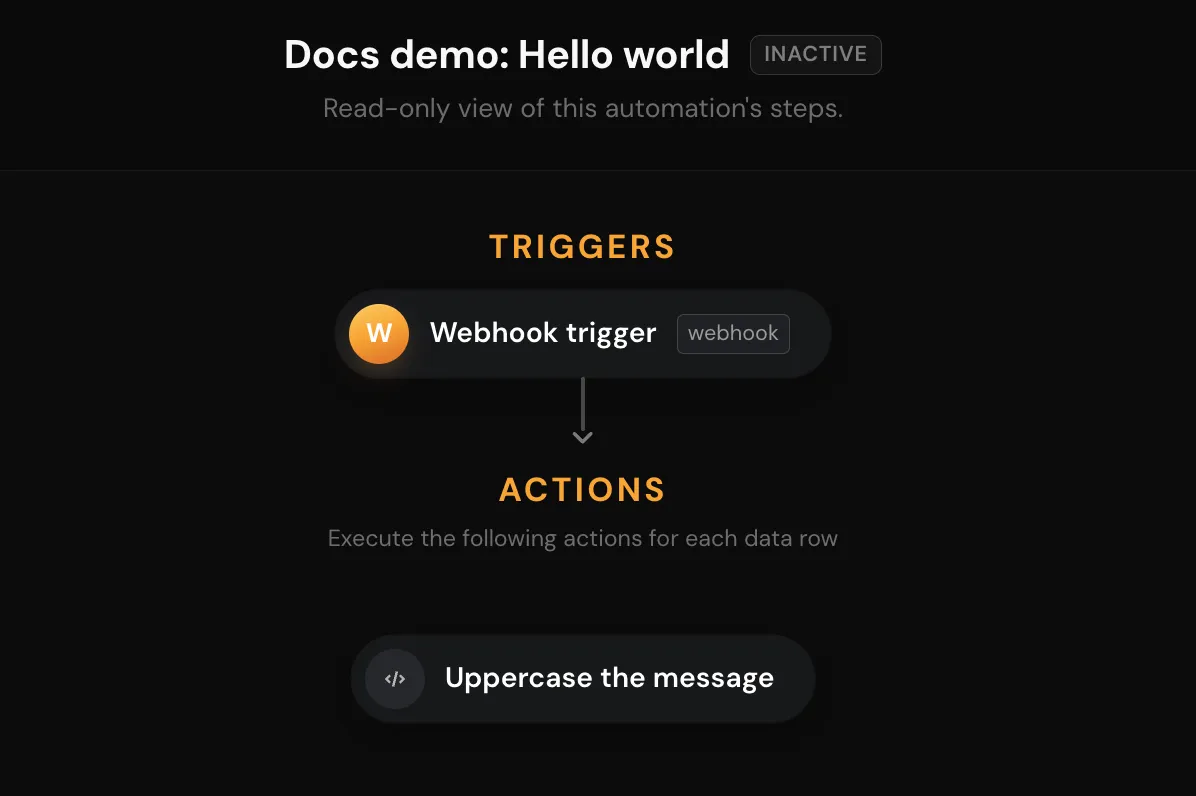
The diagram shows the webhook trigger followed by the text step.
5. Test it
Claude tests the automation after building it, with a sample payload shaped like the webhook body, and reports each step's result. If it needs to see a real payload first, it asks you to send one to the webhook URL. To run another test:
Test it with the name "ada lovelace".
6. Turn it on and send a real webhook
-
Ask Claude to turn it on:
textTurn the automation on. -
Send a request to the webhook URL Claude gave you:
bash$ curl -X POST '<webhook URL from Claude>' \ -H 'Content-Type: application/json' \ -d '{"name": "grace hopper"}' -
Ask Claude what happened, or open the automation's execution history from its dashboard row. The uppercase step's output holds
GRACE HOPPER.
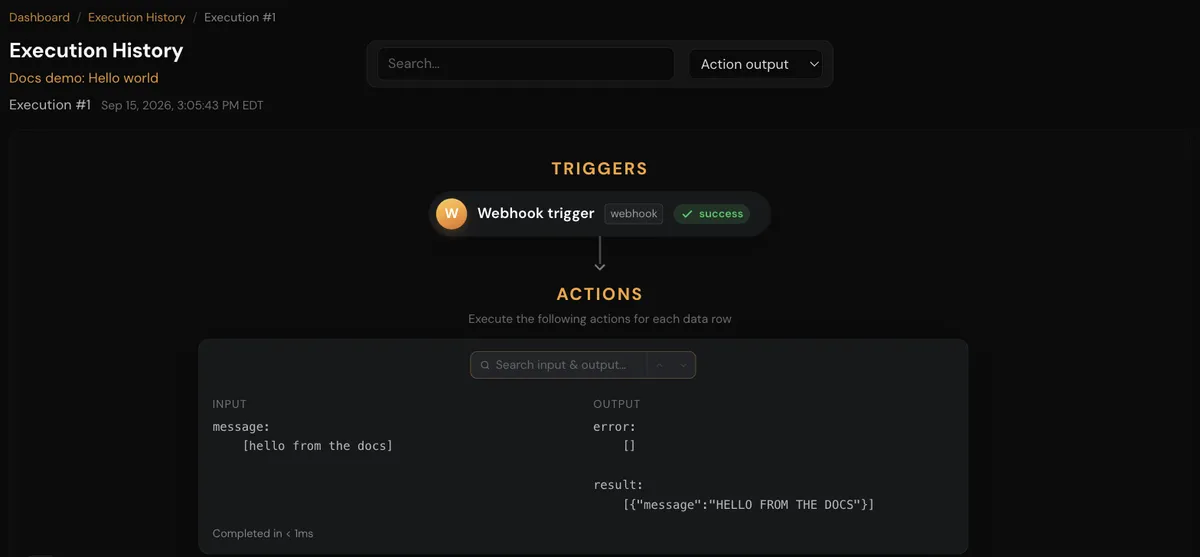
Execution history lists each run with the input and output of every step.
Result
Claude Code is connected to your APIANT account in this directory, and you have a live webhook automation. Nothing you did here used assistant credits; the runs count as tasks on your plan.
Troubleshooting
| Symptom | What to do |
|---|---|
claude: command not found | The claude command is not on your PATH. Install or locate Claude Code, then run the command again. |
| No Connect to Claude Code in the account menu | The item is hidden while you are acting as another account. Return to your own account. |
| Claude does not find the APIANT tools | Start Claude Code from the directory where you ran the command. The install is per directory. |
| Sign-in says your account does not have the MCP Tools permission | Your account's role lacks that permission. Ask your account administrator to grant it. See Authentication and permissions. |
| The webhook request returned 404 | The URL is incomplete or the automation was deleted. Ask Claude for the webhook URL again. |
| No run appears after the webhook | Check the automation is on. A webhook sent while it is off waits and runs when you turn it on. |
More fixes are in Troubleshooting MCP.