APIANT.ai / About
About
About APIANT
APIANT.ai is an integration and automation platform run by AI agents. You describe the integration or automation you need in plain language, and your agent connects the apps, builds it, tests every scenario before it ships, and keeps it running.
We've been building APIANT for 11 years. A small team started it because connecting business software meant writing custom code, and the simple point-to-point tools couldn't handle what real integrations need.
So we built a platform for the harder integration work: custom connectors for any API with documentation the agent can read, multi-step automations with branching and transforms, two-way sync, deploying the same integration to one customer or many, and monitoring it all in production. Software companies, system integrators and enterprises have used it to ship integrations as products. Along the way the work led to the patent applications described below.
When AI agents became capable of the work an integration engineer does, we made every tool on the platform operable by an agent, with guardrails. The agent reads the vendor's API documentation, builds the connector as data, tests each operation against the live API, and stops rather than guessing when it can't read the docs.
That's APIANT.ai. Your AI agent is the interface, and it's free to start.
Why it works
Every integration is structured data, not code
Deep integrations built this fast can look like a trick, or like magic. They are neither. On APIANT, every integration is stored as structured data. Each step is a node that says what it does, which app it calls, which fields it maps and where it branches.
That is what lets your AI client do the whole job. It can read an integration, change one node, test it and run it, the way you would edit one cell in a spreadsheet, while everything around it stays as it was.
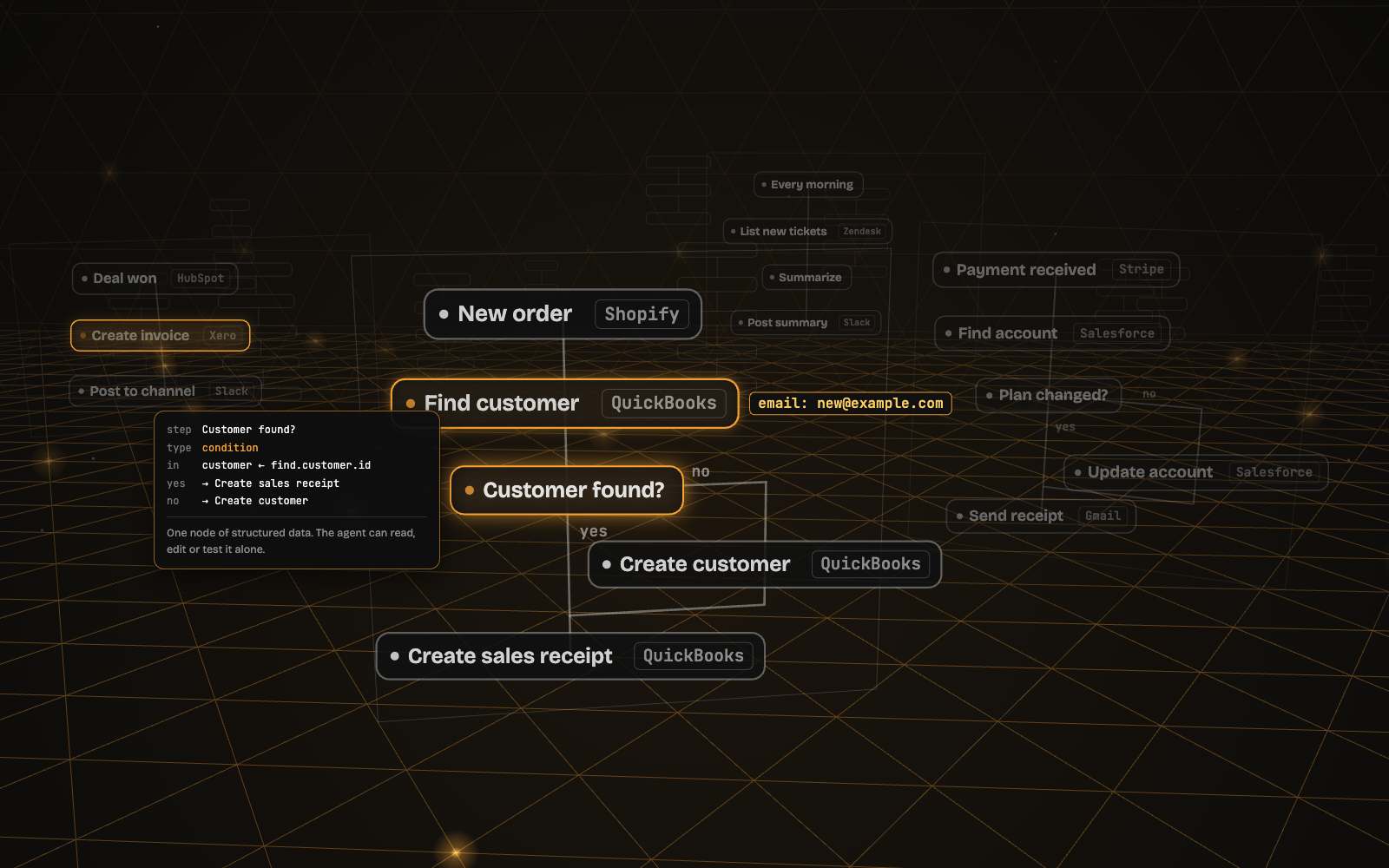
Say a Shopify order should become a QuickBooks sales receipt, and a new customer should be created first when none exists. That is a handful of nodes. To test the new-customer path, your AI client takes a saved run, changes the email to one QuickBooks has never seen, and reruns from the check.
- New order
- Find customer
- Customer found?
- Create customer
- Create sales receipt
- Deal won
- Create invoice
- Post to channel
- Payment received
- Find account
- Plan changed?
- Update account
- Send receipt
- Every morning
- List new tickets
- Summarize
- Post summary
One node of structured data. The agent can read, edit or test it alone.
Why that makes builds fast, deep and reliable
Fast
Nothing has to be written or compiled as code. The data is compact, so your AI client can hold a whole integration in view at once.
Deep
Branches, loops, lookups and two-way sync are more nodes in the same structure. Depth adds steps, not fragile code.
Reliable
A saved run can be restarted from any step, so every scenario can be tested before anything ships, not only the common one.
Transparent
Every step can be read, by you or your AI client. Nothing runs that is not in the structure.
How the AI runs the platform
Build
It reads the app's API documentation, discovers the real fields from the live API, and writes each step as a node in a private draft.
Test
It forces each path with changed data, as in the example above, and fixes what fails.
Monitor
It watches the run history for errors and traces each one to the step where it happened.
Improve
It replays the input that failed through the same path, corrects the step at fault, and tests again.
No magic: every one of these is a data operation you can inspect.
Six U.S. patent applications pending
We have filed six U.S. patent applications on the methods behind this. All six are pending. In plain words, they cover:
- Turning a request into a checked automation that uses the exact fields of your own app account, custom fields included.
- A private draft workspace for each conversation, so several agents can build at once without touching each other's work.
- Testing by saving and changing the state of a run, so no test records have to be created in the connected apps.
- A test, fix and retest loop the agent runs on its own until every scenario has been tested.
- Going from plain words to a running automation.
- Testing webhook automations without waiting for the other app to send a live event, by replaying a past one.
Contact
support@apiant.ai · 196 W Ashland St, Doylestown, PA 18901